



The article below is shared from my friend and mentor Brad Tolinski’s excellent Substack. Click on over and subscribe.
In spring of 1992, Brad, who was Guitar World Editor in Chief, set up an amazing cover story interview - with Metallica’s James Hetfield interviewing Black Sabbath’s Tony Iommi. It was one of the first of what became a GW trademark of having a younger guitarist interviewing one of their heroes.
We did the photo shoot at rented studio downtown, where Brad planned to also conduct the interview. I was GW Managing Editor, basically Brad’s wing man and my role that day was to help with the interview and anything else to make sure all went smoothly. During the photo session, Brad pulled me over and said, “They want to do it in a bar. Can you run out and see if you can find a place that would work?”
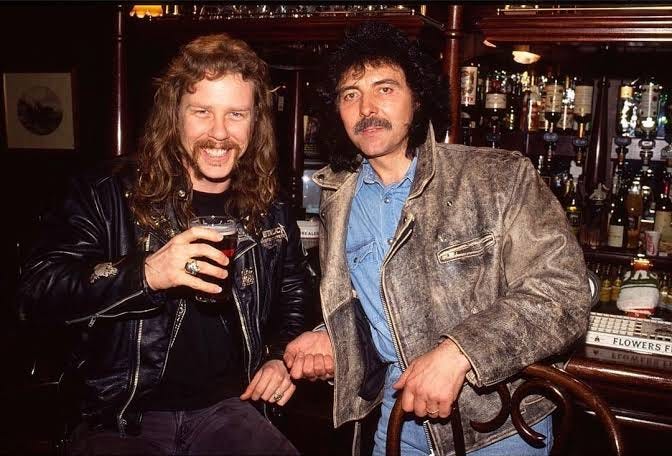
Amazingly, just a block away was a quiet, mostly empty Irish bar. I told the bartender I had to do an interview - I don’t think I gave any details - and asked him to hold the back booth for me, promising to be back within an hour. We returned, settled in back in there, ordered a round of pints, and Hetfield pulled out a neatly folded piece of paper nfilled with hand-written questions for his idol. And so it began.
Metallica’s heavy drinking habits were well known; the band was often referred to as , “Alcoholica.” James was a decade away from his first efforts at sobriety, which came in 2001 when he entered a residential rehab facility. A decade earlier. Brad and I were stupid enough to let James set the pace and he continuously signaled the waitress for another round. Tony was right there with him. So were Brad and I, but my God. I wasn’t too far off my professional drinking days, but this was something else.
The interview was really good - see below - but things got fuzzy and Tony said something that led to us getting sued and having to pay a small settlement. That’s another story for another day. After we talked and drank for an hour or more, I rose to use the bathroom and could hardly move through the pack d crowd. The bar, which was empty when we entered had filled up as Saturday afternoon became Saturday evening. Little did those downtowners downing pints know that two kings of heavy metal guitar were in their midst. I remember getting worried if the tape recorder would possibly pick up the interview amidst the growing din. Luckily, that was Brad’s problem to suss out. He tanscribed and edited the interview.
Eventually we stumbled out of there and I probably went home and went to bed. Here’s an abridged version of the interview, with Brad’s own intro. It was the cover of the August, 1992 Guitar World.
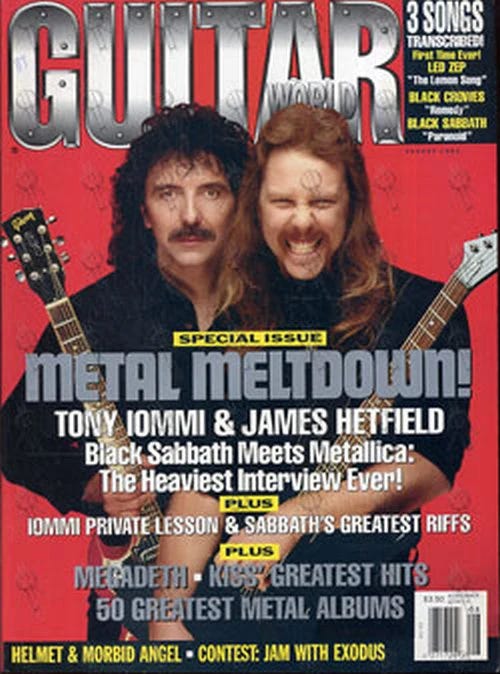
WHEN I BROUGHT Black Sabbath guitarist Tony Iommi and Metallica singer and rhythm guitarist James Hetfield together for an interview in 1992, they were meeting for the first time. Yet in a musical sense, they were hardly strangers; Hetfield had spent much of his life inhabiting a world Iommi had created.
Plenty of rock guitarists have a legitimate claim to being the most influential of all time. Jimi Hendrix transformed the sound and vocabulary of the electric guitar. Chuck Berry established the instrument as the engine of rock and roll. Eddie Van Halen reinvented its technique for a new generation. But Tony Iommi did something arguably even more consequential: he created an entire musical ecosystem.
Iommi’s innovations extended far beyond his ominous tone and down-tuned guitar. Together with singer Ozzy Osbourne, bassist and chief lyricist Geezer Butler, and drummer Bill Ward, he established the basic grammar of heavy metal: the riff as the central compositional force; the use of chromatic movement and the tritone to create menace; and the idea that sheer sonic weight could carry emotional meaning. His guitar did more than provide accompaniment or decoration. It created an atmosphere that was industrial, apocalyptic, supernatural and profoundly alienated.
Most influential guitarists inspire other guitarists. Iommi inspired genres. Doom, thrash, sludge, stoner rock, death metal, grunge, glam and industrial metal all contain some trace of his musical DNA. Even musicians who rejected Black Sabbath’s tempos, imagery or monumental heaviness embraced Iommi’s fundamental proposition: a sufficiently powerful riff could become the song.
More than a half century after Black Sabbath’s debut, heavy metal remains perhaps the most durable commercial laboratory for electric-guitar innovation. It is one of the few substantial corners of popular music in which guitarists are still expected to search for new tunings, new tones, new rhythmic languages and new extremes of precision and physical impact. Pop music continues to use the guitar but rarely asks the instrument to reinvent itself. Metal does.
METALLICA HAD CARRIED Iommi’s revolution into another generation. Guitarist Hetfield did not merely imitate the Black Sabbath sound. He extended Iommi’s method, making the riff faster, tighter and more rhythmically exact. With the enormous success of Metallica’s self-titled “Black Album,” he also demonstrated that music descended from Sabbath’s forbidding early records could conquer mainstream culture without surrendering its essential heaviness.
That is what makes this conversation more than a fascinating archival encounter between two musicians. It captures a symbolic meeting between the architect of heavy metal and one of his most consequential descendants. One man invented the language, and the other used it to address the world.
Despite metal’s typically grim disposition, the conversation with Iommi and Hetfield was anything but solemn. Conducted over many drinks at a New York tavern, with my fellow rock journalist Alan Paul joining the exchange, it proved to be a surprisingly good time with plenty of belly laughs.
Tony, what were your earliest influences?
TONY IOMMI In the beginning I was primarily influenced by old blues records. Since liner notes on most blues 78s were either sketchy or non-existent, I never knew who half of the musicians were. I still don’t.
What was your first band like?
TONY IOMMI There were six of us: the four original members of Black Sabbath plus a sax player and a slide guitar player. I think we called ourselves the Polka Tulk Blues Band, or something equally stupid. We eventually broke up so we could get rid of the sax and slide player. The four of us wanted to move away from the blues thing.
How did you make the leap from playing traditional blues to composing the heavy, riff-oriented music that characterized Sabbath?
TONY IOMMI We just became so fed up with people talking while we were playing that we said, screw it, let’s turn it up so they won’t be able to chatter. [laughs] The band just kept getting louder and louder.
Did your new sound provoke an immediate response from the audience?
TONY IOMMI After we wrote “Wicked World” and “Black Sabbath,” we thought, well, we’re going to have to try them out. When we did, everybody in the club just froze. All these blues people just scratched their heads and said, “What’s that?” The reactions were very strong, both pro and con. But I think most people enjoyed what we were doing because they had never heard anything like it.
James, how did Metallica come to pioneer thrash metal?
JAMES HETFIELD Like Tony, we also played cover tunes when we first started. We were influenced by the New Wave of British Heavy Metal, which included bands like Venom and Diamond Head—underground stuff. We learned a bunch of songs from a batch of obscure imported singles. Most people thought we were performing originals which was good for us—we took all the credit! You know: “Hey, you guys write good songs.” We certainly weren’t going to tell them the truth. [laughs]
Eventually we started playing everything faster because, just like Sabbath, the crowd wasn’t paying attention to us and that pissed us off. We decided to try to wake everybody up by playing faster and louder.
Nervousness also contributed to our sound. Our drummer Lars was always nervous onstage, so he’d play faster and faster. It was a huge challenge for us, but nobody wanted to wimp out and tell him that he was playing too fast. We just figured, hell, we’ll just play fast, too. It became part of a game.
Tony, in the early days of Sabbath, did you ever feel like you were competing with other heavy bands like Deep Purple and Led Zeppelin?
TONY IOMMI Certainly. There was always competition between Zeppelin, Purple and ourselves. In fact, Robert Plant and John Bonham were from Birmingham, which was our hometown. We all knew each other, which made it worse! John was actually my best man when I got married.
The main thing I remember about Bonham was that he was in an incredible number of groups. He’d only be in them for a week, and they’d get rid of him because he was too loud. He had this tremendous list of bands that he’d played with written on his bass drum case. He’d cross the old one off and then add the next one.
Was it hard to play in a tough factory town like Birmingham?
TONY IOMMI It had an effect on us. We were completely surrounded by violence and pollution, so that was a big part of our music. We were living our music.
What’s your best Ozzy story?
TONY IOMMI There are so many. Here’s one. We were all in an elevator in this real plush hotel, and Ozzy decided to take a crap. As he was doing it, the elevator was going down to the reception floor. The door opened suddenly, and there was Ozzy with his pants around his knees. And all these people in fur coats were just staring at him with their mouths open. [laughs]
JAMES HETFIELD I heard that your drummer Bill Ward once showed up for a tour with his only suitcase filled with beer!
TONY IOMMI Well, Bill never used to take many clothes at all. And when he did, he’d have two suitcases—one with dirty clothes and one with dirtier clothes. [laughs]
I used to do terrible things to Bill. I actually set him on fire once—honest to God. We were recording Heaven and Hell, and I asked, “Can I light you on fire, Bill?” And he said, “Well, not now.” So, I said, “Okay,” and then forgot about it.
An hour later Bill said, “I’m going home now. Do you still want to set me ablaze or what?” I said, “Sure.” So, I got this bottle of petrol, tipped it on Bill, set fire to him and—voormph! I couldn’t believe it! He went up like a Christmas tree. He screamed and started rolling around on the floor. His clothes started burning and his socks melted, and the nylon socks stuck to his legs. I wasn’t able to help him because I couldn’t stop laughing.
It was actually pretty serious, and he had to go to the hospital. I felt really bad. He had third-degree burns on his arms and legs and everywhere. The next day his mother phoned me up and said, “You balmy bastard. Our Bill is going to have to have his leg off.” She exaggerated a bit, but things like that were a regular occurrence with Bill.
Tony, you were one of the first rock guitarists to lower the pitch of your strings, which helped create Sabbath’s signature dark sound.
TONY IOMMI People would always tell me, “You can’t lower the pitch of your strings, that’s not right. I actually used several different tunings. I would try anything. Occasionally, I’d tune as much as three semitones down for Ozzy because he couldn’t hit certain notes.
JAMES HETFIELD Wow! So, you tuned down to a C# or something?
TONY IOMMI We’d try anything to make our sound heavier.
JAMES HETFIELD Wasn’t it hard to stay in tune, especially since you use lighter strings?
TONY IOMMI It was. But I had to use light strings. I had a work-related accident that cut off the tips of my fingers. As a result, I can’t bend heavier strings. I can’t even feel the strings [shows us his amputated fingers]. See, this one’s cut off, and that one’s off that way.
JAMES HETFIELD Whoa!
TONY IOMMI Suddenly, I had to develop a new way of playing. Ironically, I had the accident on the same day that I was supposed to quit my factory job to tour Germany with this group. So, when I started playing again, I had to devise a new way. I used to play a lot with my forefinger and pinkie because the two middle fingers were bandaged up. I learned to use and bend with my little finger a lot.
As you can imagine, I also had to learn to play standard chords in very unorthodox ways. Then I created these plastic thimbles that extended the length of my fingers, which allowed me to play in a more normal fashion.
JAMES HETFIELD Why did you need the thimbles? Why couldn’t you just use your shortened fingers?
TONY IOMMI There’s only one layer of skin that covers the bone. Sometimes when I’m playing, the thimbles accidentally come off and…
JAMES HETFIELD Ouch! So basically, cutting off the tips ofyour fingers indirectly led you to develop this completely unique style.
TONY IOMMI Yeah. At first I thought I was finished, because I went to all of these specialists and they said, “Forget it, your guitar playing days are over.” Then a friend of mine bought me a record by jazz guitarist Django Reinhardt and told me to have a listen. I told him I thought he was great. Then my friend said Django was only able to use two of his fingers. It started me thinking, well, if he was able to do it, I’m gonna have go. And that’s what started me on my way.
Brothers and Sisters: the Allman Brothers Band and The Album That Defined The 70s was my third straight book to debut in the New York Times Non-Fiction Hardcover Bestsellers List, following Texas Flood: The Inside Story of Stevie Ray Vaughan and One Way Out: The Inside History of the Allman Brothers Band. My first book was Big in China: My Unlikely Adventures Raising a Family, Playing the Blues and Becoming a Star in Beijing, about my experiences raising a family in Beijing and touring China with a popular original blues band. It was optioned for a movie by Ivan Reitman’s Montecito Productions. I am also a guitarist and singer who fronts two bands, Big in China and Friends of the Brothers, the premier celebration of the Allman Brothers Band.
Great interview. But, what I found most striking is what a killer writer Brad Tolinski is! Thank you for sharing.
Fascinating! Thanks Alan- I’ve never been much of a metal fan but now I’m curious to learn more. Great article 👏👏